Showing posts with label books. Show all posts

April 18, 2010

Tweets from the past


Hasn't changed much since White's day: the village of Selborne, by Mockney Rebel on Flickr.

Ebert rouses his followers on Twitter:
Has ANYBODY noticed I've been starting each day with Gilbert White's "Natural History of Selborne?"
White's journal entries, as it happens, often make perfect tweets — and now I have another book to buy. From Ebert's link, The Natural History of Selborne:
Gilbert White (1720-1793) was the curate of the village of Selborne in Hampshire, England. He was a fellow of Oriel College, Oxford, a farmer in a very small way, and a passionate gardener. From an early age he was fascinated by nature and recorded his observations, and in later life began to correspond with several prominent ‘natural philosophers’. These letters were eventually edited and compiled in a book, The Natural History and Antiquities of Selborne (1789). It has never been out of print since its publication and established the genre of nature-writing in English. Gilbert White’s commitment to close observation of the mundane and everyday in nature– what we would now call ‘field study’– was pioneering and inspired Darwin; his influence felt in pastoral English writing from The Mill on the Floss to The Wind in the Willows.
Trivia: one of White's correspondents was the Welsh naturalist Thomas Pennant, first to describe the fisher [Martes pennanti] for science in 1771. I love fishers.

Here's the Penguin Classics edition of Gilbert White's book at Amazon. Honestly, Roger Ebert's Twitter feed is the reason God created the computer.


The Summer-Maker. [Check out these beautiful shots on Flickr.]


Related: Pacific fisher [Martes pennanti], at Sierra Forest Legacy.

February 4, 2010

"Excelling in expression": three show collies


Ch. Beulah's Golden Futureson, born in 1943.

These photos were scanned from Margaret Osborne's book The Collie. I think they're three of the most beautiful dogs I've ever seen. All three were bred and born in England.

The tricolor on the left is Beulah's Nightvictorious, born in 1939.


Ch. Backwoods Fellow, born in 1930.

January 21, 2010

BIRD by Andrew Zuckerman


Andrew Zuckerman's website is here, and the book of photographs he created from the sessions above is here. H/T: Kitsune Noir.

[Update: we [Bobby at KN and I, and Lord knows how many others] were free to embed the video yesterday, but today the embed option no longer exists. Still worth watching — just click on the depressing message above to visit Vimeo.]

January 11, 2010

Link liberation: scary wolf stories


Ernest Thompson Seton: Wolf Study. Pen and ink with water color (1896).

I first read Seton's Lobo, the King of Currumpaw when I was eight or nine [thanks, Uncle Rudy, for the gift of Wild Animals I Have Known], and I can still recite parts of that story from memory.
A lion shorn of his strength, an eagle robbed of his freedom, or a dove bereft of his mate, all die, it is said, of a broken heart; and who will aver that this grim bandit could bear the three-fold brunt, heart-whole? This only I know, that when the morning dawned, he was lying there still in his position of calm repose, but his spirit was gone—the old king-wolf was dead.

I took the chain from his neck, a cowboy helped me to carry him to the shed where lay the remains of Blanca, and as we laid him beside her, the cattle-man exclaimed: "There, you would come to her, now you are together again."
That account of a great wolf's life and death just killed me. A couple years ago PBS ran a show about Lobo and Seton, called The Wolf that Changed America. [You can watch video selections here.] The website has a collection of related images, and when I saw the photo Seton took of Lobo at the end, the real Lobo, with each leg in a horrible trap, I actually broke down and cried.

Yes, I'm a child of the suburbs. [The very first subdivision to spring up in the midst of Pleasantville's fields and orange groves, but still.]

Like grizzlies, wolves fascinate and frighten me all at once.

These two stories are both hair-raising, and true, and they don't have happy endings.

Gros Ventre wolves kill 3 dogs [this article broke my heart]

Wolf kills hunting hound


Related:
Watch out, wolves of Idaho – the Becker dogs are ready to rumble [Edited to add: check out the follow-up post's beautiful photos.]
Dr. L. David Mech's International Wolf Center.
Cat Urbigkit's Wolf Watch.
Off Endangered List, but What Animal Is It Now?

June 5, 2009

Mmmm... books


Tom Stoppard and his book satchel. Photo by Tony Cenicola for the New York Times - click for bigger.

Bookshelf is a blog devoted to "interesting bookshelves, bookcases and things that look like them."

Bookshelf, via the awesome Materialicious [an all-time fave timesink]. Approving gentleman to the left is The Art Scholar by A. Martins de Barros.

January 18, 2009

Another New York Story

This one is also true and quite wonderful. It's called The Man Who Walked Between The Towers.


H/T: Nag on the Lake.

December 14, 2008

Genuine Man-eating Siberian Bloodhounds


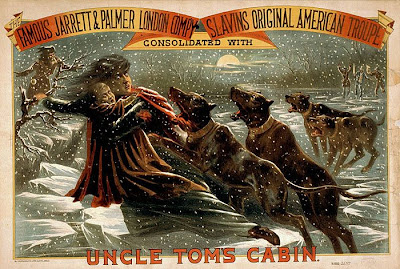
Eliza crossing the Ohio River, pursued by Genuine you-know-whats.

Fellow James Thurber-addict Carol [FrogDogz] has pointed out that for Thurber's generation — not to mention his parents' generation — the monster dog that tore people to shreds, that took hold with its fearsome jaws and never let go, was the bloodhound. Really: the friendly, slobbery bloodhound.

Remember when a girl could be ruined by a book? Back in the 1800s a dog could be ruined by the theater. The bloodhound's reputation tanked after the publication of Uncle Tom's Cabin: a book I have never actually read skimmed today that contains a scene, or so I thought, where a runaway slave, her child in her arms, tries to cross the frozen Ohio River with a pack of vicious bloodhounds in hot pursuit. I know about this scene because my parents had in their library an amazing picture book of American history, with an image of a theater poster for Jay Rial's Ideal Uncle Tom's Cabin. Actually, the poster reads Jay Rial's Genuine Trained Bloodhounds. And in smaller letters, below the illustration: With Jay Rial's Ideal Uncle Tom's Cabin. The artist was Matt Morgan. From Bandwagon:
Matt Morgan, a leading lithographic artist of the period, joined the firm [Strobridge, "synonymous with circus posters"] in 1878, after spending five years with Leslie's Weekly as a cartoonist. Morgan's arrival brought the creation of the first Strobridge multiple-sheet poster, in the form of a 16 sheet [outdoor poster]. The subject was "Eliza Crossing the Ice."
I can find no reproduction of this poster online, and will have to scan it the next time I'm downtown. The book's reproduction of the poster is in black and white. The dogs are big, entirely lifelike and and vividly believable, with close-cropped ears and the slick coats of a pit bull or an American bulldog. They look absolutely ferocious, even if you are not an impressionable eight year old. The caption: Eliza's race across the Ohio River, shown in an Uncle Tom's Cabin theater poster, was often duplicated in real life. One Negro woman who was caught on the Ohio side cut her baby's throat as they were carried back to slavery. [Author Harriet Beecher Stowe exaggerates the separation of slave children from their families, complained a critic: Louisiana law clearly states that “Every person is expressly prohibited from selling separately from their mothers the children who shall not have attained the full age of ten years."]

In the book, as it turns out, there are no dogs chasing Eliza across the frozen river. Stowe never mentions bloodhounds in Uncle Tom's Cabin [thank you, Project Gutenberg and Control+F], and she refers to Simon Legree's slave-chasing animals as bull-dogs, a familiar type. But theater impresarios of the 1800s guessed correctly that nothing would sell tickets like man-eating bloodhounds, with the possible exception of Genuine Man-eating Siberian Bloodhounds, so the dogs became central to stage productions of Uncle Tom's Cabin, and the breed became famous for viciousness and unpredictable savagery.

All images in this post are from the web site Uncle Tom's Cabin & American Culture: A Multi-Media Archive.

Absolutely, positively.


Another scene not found in the book. Are those Mexican bandits up on the cliff? Because that would be awesome.


One is left speechless.


From the NY Times, May 29, 1883:


You had to be there:

[File under Disbelief: Willing Suspension of.]

November 2, 2008

The Red Vote

Author Sherman Alexie explains to Stephen Colbert why 90% of American Indians Native Americans our nation's indigenous peoples are voting for Obama.


[H/T: The Unapologetic Mexican.]

September 29, 2008

For Frogdog


Click for bigger.

From the NY Times: library in a private home in Cuernavaca, Mexico. Snap up this colonial-style property for a cool $2.5 million. [Frenchies not included.]

September 28, 2008

I read banned books


Click for big.

September 27 – October 4, 2008 marks the 27th celebration of the freedom to read and the freedom to choose what we read. Banned Books Week: Celebrating the Freedom to Read "reminds Americans not to take this precious democratic freedom for granted."
Banned Book Week celebrates the freedom to choose or the freedom to express one’s opinion even if that opinion might be considered unorthodox or unpopular and stresses the importance of ensuring the availability of those unorthodox or unpopular viewpoints to all who wish to read them. After all, intellectual freedom can exist only where these two essential conditions are met.

BBW is sponsored by the American Booksellers Association, American Booksellers Foundation for Free Expression, American Library Association, American Society of Journalists and Authors, Association of American Publishers, National Association of College Stores, and is endorsed by the Center for the Book in the Library of Congress.
Research Maven Lisa Gold has written a fine post in honor of Banned Book Week, with a reading recommendation on the subject of censorship. More information here, at the American Library Association site, and because I'm all about the swag, visit the ALA store to order your "I Read Banned Books" accessories.

September 10, 2008

I've found my people

Library of the Abby of Saint Gall, the oldest library in Switzerland.

"My dear Selena,” I said, “to be always right is the claim of the charlatan, not of the Scholar. The mark of Scholarship is a fearless and unflinching readiness to modify theories in the light of new evidence.” [ Sarah Caudwell, The Sybil in Her Grave.]
I was no more than half a dozen lines into Lisa Gold's new blog, Research Maven, when I knew I'd struck pay dirt:
The next best thing to knowing something is knowing where to find it.” — Samuel Johnson

I thought this famous Samuel Johnson quote would be an appropriate way to begin my blog. The problem is that Johnson never actually said this, despite the fact that you’ll find this attributed to him on a number of different quotation websites. None of these websites identified the original source of the Johnson quote, so I decided to dig a little deeper.
"Research is like treasure hunting, and to do it well you must be skeptical, curious, discriminating, persistent, and willing to look beneath the surface," writes Gold. Amen. Research Maven looks like a keeper.

August 15, 2008

HE NOT DEAD! Stop be sad.


Click for big Bigfoot.

That business in Georgia? Totally a hoax. For the straight dope on Bigfoot, see Me Write Book: It Bigfoot Memoir and Bigfoot: I Not Dead, both prepared in collaboration with someone named Graham Roumieu. [Press release via the Bigfoot fanboys and fangirls at BoingBoing.]

March 28, 2008

Sheep serif


Even the i is dotted. Well done, ladies.

North Devon shepherd/author/filmmaker/television personality David Kennard can add "performance artist" to his resume with this gem.
Sheepdogs are trained to obey their master's every word. So when farmer David Kennard decided one of those words would be "Spring", his dogs did not hesitate.

They rounded up the flock on the hills of Mr Kennard's north Devon farm and, with a little help from their master, created a picture that reminds us that, whatever the weather, this is officially the first weekend of Spring.

The scene did call for a careful scattering of feed to make the sheep form themselves in the shapes of the six letters.

However, it was down to the team of Collies – who everyone knows border on the brilliant – to have the last word. They circled the 200-strong flock and kept them from wandering off-message.
Thanks to Carol of Frogdog Blog for the tip — visit her most excellent blog to read more about Kennard and his border collies.
And also, oh look! A book about sheepherding, by someone who is… an actual sheepherder! Someone send a note to Jon Katz about this.
Snerk.

Kennard [below with Ernie, Swift and Greg] knows how to pen compelling accounts of farm life, and it doesn't hurt that he shepherds in breathtaking country:


A Shepherd's Watch has excellent photos to supplement Kennard's writing, and The Year of the Working Sheepdog is a classic video: read a review here.

Kennard knows a thing or two about sheepdogs. He had a respectable showing with Swift and Greg in brace competition at the 1999 International Trial. From A Shepherd's Watch:
Greg was obviously aware that this was a brace run, and on arriving at the sheep had lain down and waited for a minute or so for his partner to arrive without a command from me. When Swift appeared, he simply got to his feet and moved across to his side of the sheep. I don't know how many people noticed his reaction, but it was something that I'll never forget.
The sheep in the photo at the top of this post are Kennard's North Country Mules. To learn more about mule sheep, see Dr. Mark Lelli's excellent Muleflock website.

March 27, 2008

Estate Auction: dog related fine and decorative arts


Bonhams & Butterfields Sunset Estate Auction, Los Angeles, March 30, 2008. Click for big.

The collecting bug: one minute you're happy with two or three porcelain sheepdogs and a "Ban Stupid People, Not Dogs" mousepad, and the next thing you know, you're on eBay in a bidding war for a set of kissing-pugs salt and pepper shakers. Or at Christie's bidding on a Hockney etching of a dachshund. Or both.

This Sunday, one of the world's largest collections of dog-related art and memorabilia will be sold at auction in Los Angeles. Bonhams & Butterfields is in charge, and you can visit their site to see some of the wonderful old tintypes and photographs of dogs from the Jennifer Berry collection. Lots of working collies and pit bull types, and many other breeds -- even sheep!
Over the past five decades, Los Angeles collector and animal lover Jennifer Berry has amassed what is surely one of the largest collections of dog-related memorabilia in the world. Housed in her prestigious Brentwood Hills, California home, it has remained virtually unknown but to close family and a handful of collectors[...]

Within the highlights is photography, embodied by highly sought after daguerreotypes, ambrotypes and tintypes. Almost all of images feature dogs sitting for a portrait. Considered highly desirable to both photography collectors as well as dog art lovers, these seminal images document not only the practice of early photographic portraiture, but accurately depict the state of various breeds in the 19th century. [Source]


Old books, too. From the Bonhams & Butterfields site:


Sale 15882 - Sunset Estate Auction

30 Mar 2008
7601 Sunset Blvd., Los Angeles

The March Sunset Auction features the Jennifer Berry Collection of Dog related fine and decorative arts[...]

Viewing in our Los Angeles Gallery:
Friday, March 28th 10:00 AM - 5:00 PM
Saturday, March 29th 10:00 AM - 5:00 PM
Sunday, March 30th 10:00 AM - 12:00 PM

Representatives from spcaLA will be on hand during the preview to provide information on their programs and services for our clients.
Meanwhile, back on the Bay:


"Girl w PIT BULL DOG Staffordshire Terrier Original CDV card photo dated 1866 England."

I want 'em all.

December 23, 2007

Good blogging

Clearly, the author has better things to do than decorate dropcaps ;~) That blogger would be Stephen Bodio [a longtime Terrierman favorite], and this past week his Querencia included photos of an Anatolian LGD squaring off with a burro; a discussion on the merits of hunting cranes [prompted by my own fave blogger Julie Zickefoose]; and a link to a New Yorker review by Bill Buford of "three books by authors from three backgrounds—a farmer, a chef, and a pig-slaughtering, bacon-loving descendant of butchers — remarkably alike in their gleeful chauvinism about being carnivores." The River Cottage Meat Book, writes Buford, opens with "an eleven-photograph sequence that shows the author taking two cows to slaughter":
The pictures are not sensational, but they are unflinching [...] Why is it considered entertainment when a predator kills another animal in a wild-life film, Fearnley-Whittingstall wonders, “whereas the final moments of human predation of our farmed livestock are considered too disturbing and shameful to be made available even for information.” The reader understands the point. Meat comes from an animal—a banal connection that has been obscured by the way supermarkets prepare and present our food—and the animal has to be killed. If you fear the sight of a carcass, you shouldn’t be eating from it.
All this, and not a marching Santa in sight. Two opposable thumbs up.