November 28, 2008

Good eats and good reads: on raising - and killing - lamb for dinner

Louise Erdrich looked at the northern tallgrass prairie and wrote:
I would be converted to a religion of grass. Sleep the winter away and rise headlong each spring. Sink deep roots. Conserve water. Respect and nourish your neighbors and never let trees gain the upper hand. Such are the tenets and dogmas. As for the practice — grow lush in order to be devoured or caressed, stiffen in sweet elegance, invent startling seeds — those also make sense. Bow beneath the arm of fire. Connect underground. Provide. Provide. Be lovely and do no harm.
Provide. Here is California farmer Andy Griffin, author of The Ladybug Letter, writing about "the karma of meat":
[C]ooking meat is the way nature allows us to eat grass. By profession I’m a vegetable farmer, but as a hobby I keep a flock of goats and sheep along with a tiny herd of Dexter cattle and I think of them collectively as my “meat garden.” My animals eat cull vegetables, like over-ripe tomatoes, under-ripe winter squash and deformed beets, but mostly they eat grass from the hillsides around my home that are too steep and dry for me to farm. Remember the Dust Bowl? One of the most profound and long-lasting catastrophes of the “dirty thirties” was that speculation in grain caused vast tracts of arid, marginal land in the western Great Plains to be ploughed down for wheat. When the drought came there was no turf to hold the soil down and it blew away. That land should have never been taken away from the Buffalo and the beef cattle.

"Cooking meat is the way nature allows us to eat grass."
Andy Griffin


And when Andy says "beef cattle" he isn't talking about the "karmically-challenged modern beef steer" fattened on corn in a feedlot. People, there's a reason Isaiah says in the Bible, "All flesh is grass." [A reason that has nothing to do with meat for dinner, but still.]

Everything dies. If we are conscientious, the stock we raise will die with as little stress as possible after a comfortable life. And this beats being chased down and torn apart while still alive, or wasting away from injury and infection, or dying of some hideous parasite-borne condition on the African savannah, if you ask me. [Full disclosure: when an earnest vegan says, "I am someone who cares about preventing cruelty to animals," I want to say, "Dude -- like Battle at Kruger?"] As the man wrote, "No wild animal dies of old age."

All of this is by way of introducing some links to excellent posts on raising sheep [and other stock] for slaughter, and dinner.

First, from the always terrific Bill Fosher [owner/moderator of the Sheep Production Forum]: Honor thy meat.

I loved this:
Q: “How do you eat meat from animals you knew?”
A: “I don’t like to eat meat from an animal I didn’t know!"
True, true — the only lamb I used to eat, before free-range and grass-fed became trendy, was barbecued on a friend's ranch not long after being slaughtered. The person sitting across from me at the table could tell me everything about that individual lamb, from its grazing habits to the name of its great-grandma. I knew where that lamb came from and what care it received. Who do you ask about the shrink-wrapped ground beef at Whole Foods?


Ardi Gasna has been in my blog list forever, and back in April, California chef, sheep dairy owner and artisanal cheesemaker Rebecca King wrote about slaughtering lambs she'd raised:
I know some may find it morbid (although they themselves eat meat that someone else kills!), but I've discovered I actually enjoy slaughtering and butchering my own animals. There is a certain satisfaction in knowing that I was responsible for this animal from its birth until its death. I am also fascinated in the process by which a living thing becomes food that we eat. The lamb has been really delicious as well, some of the best I've ever had.
As it happens, Andy Griffin of Mariquita Farm and The Ladybug Letter has crossed paths with Rebecca and her sheep. Small blogosphere.

Farmer and Honest Meat blogger Rebecca Thistlewaite also has some words on lamb, specifically: "So the California raised grassfed lamb tasted better, but why does it cost so much more?" Read the rest in her post The Real Dirt on Lamb.

And what about the actual, you know, slaughter? How much easier it is for the animals when they are killed quickly at their own farm or ranch, without the stress caused by transport to a distant slaughterhouse! So why aren't there more MPUs?

That truck on the left is a mobile slaughterhouse, or MPU - Mobile Processing Unit. From The WSJ's Have Knife, Will Travel:
Scott Meyers of Sweet Grass Farm Beef [on Lopez Island, Washington] started raising Japanese Wagyu cattle on his grass pasture once the mobile unit was up and running. "It gave me access to the marketplace," he says. "Without that, I wouldn't have even considered" raising beef.

Mr. Meyers says the mobile unit offers his animals a "sublime" death because they avoid the stress of traveling long distances. Such care makes his beef taste better, he says, as he introduces part of his herd: "This one's Violet, here's Splits and Buttercup."
The Ethicurean has more on the Island Grown Farmers Cooperative here.

But that's Washington State. Are there any mobile rigs in California?

Sort of. Marissa Guggiana explains in Leading Lambs to Slaughter — In search of a kinder, gentler abbatoir:
Right now there are seven operating MPUs in the U.S., but none of them are in California. California’s lone MPU sits gathering dust in Monterey County. The MPU is operated by George Work, of Work Family Ranch. Work’s enthusiasm for the practicality of the MPU got it built, but it hasn’t been enough to overcome state and county bureaucracy, and a federal regulatory system that seems reluctant to change.
[...]
The general response from other meat processors, government workers, and members of the sustainability community to the MPU is a list of reasons why it does not work, has not worked, and will not work. Most of these focus on county regulations. For instance, in Washington, where [Bruce] Dunlop operates, he’s able to compost the non-edible remainders and return them to the pasture as fertilizer. In California this wouldn’t be tolerated. While each county has its legal peculiarities, there seems to be an overarching resistance rooted in a fear of decentralization, a fear that if we move outside the model of faster, cheaper, and more, we lose.
We'll see what happens once the new administration takes over, though I suspect MPUs are not high on the list of concerns at the moment.


Related posts from this blog, with much link goodness.

Hey, that'd be a good title for a book!

And finally, from one of the links above:
Keep in mind one of the oldest ways to get "free-range, grass-fed, organic, locally produced, locally harvested, sustainable, native, low-stress, low-impact, humanely slaughtered meat": by hunting it yourself.

November 27, 2008

Blessings, I haz them


From The Omnificent English Dictionary In Limerick Form: a poem for the day, by Richard Stehr.
Blessings

When you're facing that Thanksgiving spread
And the plentiful feast you'll be fed,
It's a time not for counting
The calories mounting
But counting your blessings instead.
May everyone enjoy a happy Thanksgiving holiday, and a safe and satisfying Black Friday [and Cyber Monday!].

[Hat tip to the most excellent Barbara Wallraff.]

November 24, 2008

New books: Wolves, and a parrot

Querencia blogger Cat Urbigkit has a new book out: Yellowstone Wolves: A Chronicle of the Animal, the People, and the Politics. Cat and her family raise sheep and cattle in western Wyoming and she has been following the wolf situation in that area for years. [Click on Wolf Watch at this link to read more.] Stephen Bodio of Querencia has written an excellent post about Cat's book, which he reviews in his spirit wolf voice. I kid ;~) Yellowstone Wolves looks like a good read.

Another new release: scientist Irene M. Pepperberg has written a book about her decades-long partnership with Alex, the famous parrot who died last year at the age of 31. From today's NY Times review:
Her book movingly combines the scientific detail of a researcher, intent on showing with “statistical confidence” that Alex “did indeed have this or that cognitive ability,” with the affectionate understanding that children (and children’s books about animals) instinctively possess: that “animals know more than we think, and think a great deal more than we know.” While her training as a scientist keeps her from lapsing into sentimentality, her love for her longtime avian colleague keeps her from sounding like a stuffy academic.
Read the whole review here. The book is Alex & Me: How a Scientist and a Parrot Uncovered a Hidden World of Animal Intelligence — and Formed a Deep Bond in the Process.

No place like home


New Zealand: Drift Bay House by Kerr Ritchie Architects. More photos here, at Arch Daily. [H/T x3 to Materialicious.]

How I love you, o precious week of Thanksgiving vacation...! I might be up at the family cabin now, but am hunkering down here at home instead, happy for the extra time to spend with a dear old dog and eager for the anticipated rain.

Speaking of cabins and other dwellings that make me happy:

Another shot of the New Zealand home by Kerr Ritchie Architects. [Click for big.] Pity about the view.


In Montana, a Forest Service lookout-style cabin perfect for the grizzly-averse [like yours truly]. Slide show here, along with a NY Times article on the new cabinistas.


This one, on a rocky outcropping in Fosen, Norway, is Cabin Vardehaugen by architecture studio Fantastic Norway. More photos here.


Casa Lago Rupanco in Chile, by F3 Arquitectos. I want. Slide show here.

This is insane

So my beautiful California is burning up — and both Laura and Heather claim it's... snowing. And they have photos — gorgeous, amazing photos — to prove it. Unreal.

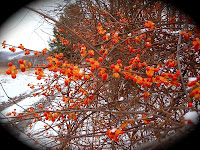
Check out Laura's scary post on the worst South Dakota blizzard in 30 years — photos here. And the weather went all Andrew Wyeth [did I mention how much I love Heather's writing?] over at the most excellent Raised by Wolves. I swiped the photo above from Heather's blog because I love the colors. More of her snow scenes here.

November 22, 2008

Indifference to the truth is worse than lying: BSL and the curse of false equivalencies

The truth is not "somewhere in the middle."

Here is the truth about breed-specific legislation, from veterinary animal behaviorist Dr. Karen Overall: "Breed specific laws are not based in science. [Laws] banning breeds will not make you safer, and the illusion that they will do so is dangerous to humans and unfair to dogs."

The facts back her up. So why are various city councils so determined to ignore the science? Because it's easier to imagine that the truth is somewhere in the middle. It requires less courage and a lot less work. Russell Baker — quoted by the late, great Molly Ivins back in 1987, so help me, and things haven't gotten better — explains how "balance" works. Boldface is mine:
In the classic example, a refugee from Nazi Germany who appears on television saying monstrous things are happening in his homeland must be followed by a Nazi spokesman saying Adolf Hitler is the greatest boon to humanity since pasteurized milk. Real objectivity would require not only hard work by news people to determine which report was accurate, but also a willingness to put up with the abuse certain to follow publication of an objectively formed judgment. To escape the hard work or the abuse, if one man says Hitler is an ogre, we instantly give you another to say Hitler is a prince. A man says the rockets won't work? We give you another who says they will.

The public may not learn much about these fairly sensitive matters, but neither does it get another excuse to denounce the media for unfairness and lack of objectivity. In brief, society is teeming with people who become furious if told what the score is.
And here is Ivins herself [both quotes from her book Who Let the Dogs In?]:
The American press has always had a tendency to assume that the truth must lie exactly halfway between any two opposing points of view. Thus, if the press presents the man who says Hitler is an ogre and the man who says Hitler is a prince, it believes it has done the full measure of its journalistic duty.

This tendency has been aggravated in recent years by a noticeable trend to substitute people who speak from a right-wing ideological perspective for those who know something about a given subject. Thus, we see, night after night, on MacNeil/Lehrer or Nightline, people who don't know jack about Iran or Nicaragua or arms control, but who are ready to tear up the pea patch in defense of the proposition that Ronald Reagan is a Great Leader beset by comsymps. They have nothing to offer in the way of facts or insight; they are presented as a way of keeping the networks from being charged with bias by people who are replete with bias and resistant to fact. The justification for putting them on the air is that "they represent a point of view."

The odd thing about these television discussions designed to "get all sides of the issue" is that they do not feature a spectrum of people with different views on reality: Rather, they frequently give us a face-off between those who see reality and those who have missed it entirely. In the name of objectivity, we are getting fantasyland.
Now imagine a city council meeting, which shouldn't be too much of a leap. Members of the city council are 1) debating whether to ban certain dogs based not on their behavior or temperament but on their physical appearance, and 2) turning their backs on the concerns of law-abiding citizens whose good dogs have never harmed or threatened to harm anyone.

There are two opposing points of view.
  • Strongly opposed to breed bans are the real experts at the CDC; the AVMA; the authors of A Community Approach to Dog Bite Prevention; and virtually every competent dog-trainer, veterinary animal behaviorist and humane organization in North America.

  • In favor of breed banning: someone who quotes an odd "study" lacking citations and footnotes and filled with misspellings, misstatements and some of the nuttiest dog behavior analysis since Thurber's mother.

And the city council, if it is sufficiently replete with bias and resistant to fact [not all of them are, thank God], will pat itself on the back for its "balance" and cast its deciding vote in favor of those who have missed reality entirely.

"We create our own reality," as the man said. The truth is somewhere in the middle! So we ignore science, we fill law-abiding citizens with anguish, and when we feel like it, we confiscate and kill their good dogs.

*************

Those who like to keep their bullshit detectors honed might want to check out the links in the Vagabond Scholar's posts on Faulty Argument Patterns and False Equivalencies. H/T to Batocchio for the Molly Ivins lead.

[Universal B.S. Detector Watch from Gizmodo.]

Flashback


Indeed. From danagraves on Flickr: click for big.

Rikyrah over at Jack & Jill Politics makes a great point: the U.S. military allows people like this to join up — and kicks out people like this?

"Lax enlistment standards have inadvertently allowed thousands of gang members to join the military, including young men who belong to the Crips, Bloods, Latin Kings, and various white supremacist groups."


From The Web of Language:

Secretary of Defense Bob Gates sees no irony in the fact that the military finds convicted felons and illiterates less morally problematic than well-educated homosexuals without so much as a parking ticket on their records who might actually be able to understand what the enemy is talking about (not to mention what our Iraqi “allies” are really saying). Gates insists that in drumming out the translators, the army is simply following the law, a law which he has no intention of reviewing.
It's long past time to review the "Don't Ask, Don't Tell" policy. As Barry Goldwater is reported to have said, “You don't need to be ‘straight' to fight and die for your country. You just need to shoot straight.”