Showing posts with label cattle. Show all posts

October 29, 2007

The Fire Coast


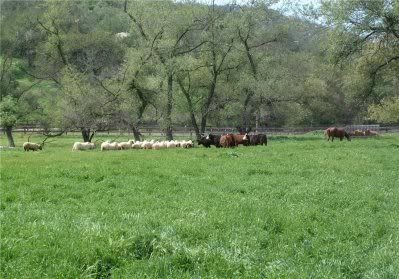
East of Pala, looking south towards the Rincon Reservation from Palomar.

The wind was still savage when we went to bed at ten, the sky swept clear, aglitter with stars. Anacapa flashed its warning light. The cypresses, pines and eucalyptuses were noisier than the surf. Cats' fur threw sparks when stroked. We slept in spite of the sinister atmosphere.

I woke up abruptly at four to see a fierce glow in the sky . . . God, the whole face of the mountain was burning, in a long line just below the summit, and moving toward us on the wind. Fear dried my mouth. I knew doom when I saw it.

The passage above [by Lawrence Clark Powell] and this post's title were taken from an essay written in 1996 by Mike Davis.

Those are clouds in the photo, not smoke. I took that shot during a cold July rainstorm in 2006, on a drive through the country that burned this week. [You want a fire photo, go here. Or here, to see what happened to the countryside above. More L.A. Times photos.]

Here are a few links with some of the most comprehensive information on the fires: lists of homes destroyed, emergency contacts, insurance news, water safety bulletins, animal care and quite a bit more.

Google Earth + Fire Overlays
Click here for links to [free] downloads of Google Earth and an [almost] real-time fire overlay. October 23 screencaps show the fires at their early worst.

InciWeb
Not always the most current information on wildfires --- but it's official.

San Diego 2007 Wildfires Wiki
Everything about the San Diego wildfires. Hundreds of useful links.

San Diego County Emergency Homepage
Essential, continuously updated information for San Diego County. Fire maps, water safety, evacuation centers, cell phone notification sign-up and much more.

San Diego Fire Recovery Information
Official site with information for affected residents.

SignOnSanDiego
Excellent coverage of the San Diego County fires: forums, maps and emergency information.

News 8 Wildfire Resource Page
More information for San Diego County residents.

Orange County Fire Authority
Updates on evacuations, fire status, arson investigation and more.

Rim of the World
Detailed information on Lake Arrowhead, Running Springs and other communities in the San Bernardino mountains: fire damage reports, forums, scanners, more. Continuous updates.

SoCal Mountains
Information for the Big Bear Lake area and other San Bernardino mountain communities. Fire information, damage reports, weather, scanners, live chat and more. Continuous updates.

San Bernardino County Emergency Homepage
Information on evacuations, school closures, utilities, assistance and more.

Wikipedia: October 2007 California Wildfires
Hundreds of wiki-facts and links. Continuous updates.

We need more of this, if you ask me. Sheep and cattle, too.

Last, but far from least: the Wildland Firefighter Foundation.


Colin Fletcher wrote that Fortune is infatuated with the efficient.

Defensible space.

Papers, prescriptions, pets and photos.

Be safe.

October 10, 2007

Great read: The Dog Wars by Donald McCaig


At the 2005 USBCHA Finals, Dennis Gelling's Jan stops a collared sheep from joining the others during the shed. Photo by Denise Wall: used with permission.


I should be in bed, dammit! But Donald McCaig's book The Dog Wars has received a fine review from Terrierman and a mention from Gina at Pet Connection, and I'd like to add some comments of my own. [Besides, to borrow a line from Birdchick: "I'm siiiiiick, I'm siiiiiiiiiiick, pity me" does not qualify as a blog entry.]

McCaig's essential history of the border collie versus the AKC belongs in everyone's library. It's about good dogs, about bad things that happen to good dogs when the American Kennel Club gets control of them, and about the major public-relations nightmare the AKC brought upon itself by "recognizing" the border collie against the wishes of virtually everyone who cared about the breed.

And McCaig goes the extra mile. He places working sheepdogs and the AKC in a historical context of socioeconomic changes and political shifts that have affected all dogs and their owners:

The historical fluke that gave the dog fancy and its regulatory body, the AKC, dominion over American dogs has had unfortunate consequences, the worst of which is that no better dog government has emerged to help our dogs survive the rough ordeal of American life in the twentieth-first century.

Because the AKC is the de facto government of dogs, and because the AKC is obsolete, the laws that most affect America's dogs are often made by those who fear them, sentimentalize them, or are only interested in their suffering. Dogs and dog owners endure an ever more dog-hostile culture without a champion.

I know tax paying American citizens who dare not drive through Denver with their dogs.

[All quoted sections in this post are from The Dog Wars.]

Buy it, read it, loan it out and talk it up. This book is a classic -- one of the most important dog books I've read in years.

*************

The only thing bellicose about The Dog Wars is its title: the writing itself is comfortable, blunt, ironic in McCaig's dry fashion, and evenhanded to a fault. (You may have to be a stockdog person to pick up the full measure of rage and pity over once-useful dogs reduced to a fluffy coat and artificial ear-carriage.)

The conflict McCaig details is the effort to save the border collie --- a matchlessly keen, athletic, biddable dog once measured solely by its ability to work stock --- from the control of an organization that values appearance above working ability, and from breeders who confuse titles with merit.

At stake is the breed's essence: quite literally, its heart and soul. Obedience people used to joke that "training a border collie is cheating," and many of these dogs are certainly intelligent and intuitive. But a good working dog on stock is something else. Says Texas handler Red Oliver: "He's obeying a higher master."

At my elbow a tough old ranch woman muttered, "We ask so much of them. And the damn fool dogs go out and do it!"
You don't train a sheepdog, McCaig says [and by "sheepdog," he and other stockmen have always meant border collie], you summon the dog's genetics. You ask them to do what they know already. You ask for miracles -- 180 ewes saved from a storm, escaped rams caught -- and you get them. After a while you may take the miracles, and the dog, for granted.

The farm where I keep my sheep is just twenty acres, but the land has a deceptive roll, and it's commonplace for my border collies to be sent to pastures to gather sheep out of my sight. The first time I did this, nearly twenty years ago, I had no choice --- there was an emergency at the house. I had never sent my young dog for sheep without a flanking command, but she knew what I wanted and would have responded the same if I'd spoken to her in Zapotec. I said, "Go get 'em," and my good girl ran across a five acre pasture, up a barbed-wire lane with cattle corralled on one side, into another pasture, down a slope and across a swampy swale to gather the sheep. She brought them across the water (they hated that), up the hill, past two open gates that led to other pastures, past the cattle corrals the sheep could have slipped into with ease, and calmly trotted them across the five acre pasture to my feet. I thought all this was quite remarkable, until I saw her do a half-mile gather in the steep hills of the Central Coast: she looked as if she'd been running out across the hills for sheep all her life, and in a sense, she had been. You don't "train" a border collie to work stock.

Ten or fifteen years ago I remember a well-known obedience trainer turning up her nose at "rejects from herding" on the grounds that they must not be as smart or as trainable as stockdogs that make the grade. This is comparable to Harvard Medical School's turning down a brilliant applicant because he wasn't a first round NBA draft pick.

If trainability and smarts were all it took, my pit bulls would be running in the USBCHA Finals.

*************

Producing a good stockdog is a bit trickier than breeding for an oblique eye-set*. Is your future breeding prospect keen and sound enough to keep working despite harsh conditions and, god forbid, injury? Does he listen? Does he come from a line noted for its stamina? What livestock has he worked? Is he a good lambing dog? How does he deal with pressure? Is he too focused on the lead ewe -- or not focused enough? Is he a trifle sticky? Clappy? Loose-eyed? Does he run wide? Does he tend to slice his flanks? Is he fast and bold enough to cover anything that breaks? Is he savvy enough to prevent a break before it happens? What kind of grip does he have? Will he balance the sheep, driving and gathering, no matter how strong a draw in this or that direction? How well does he adapt to unfamiliar terrain? Is he patient? Kind to his stock? What breeding would enhance his strengths without exaggerating them?

It should be blindingly obvious to anyone that the border collie's drive, athleticism and brains are due to centuries of selective breeding for stockwork. This is the reason that border collies produced by U.S. versatility breeders are seldom more than a generation removed from true working dogs -- take a look at the pedigrees of the top AKC agility winners -- and the reason the AKC's "parent club" for the border collie fought so hard to keep the AKC studbook open to working registries.

(Australian breeders were surprised and a bit hurt that the new AKC breed club chose not to adopt the Australian show standard --- after all, Australians had "perfected" the breed [that is, standardized its appearance at the cost of working ability]. But their "Barbie collie," as it was promptly nicknamed, was exactly what U.S. versatility breeders hoped to avoid: a lumbering, comparatively dull creature that looked like a small Newfoundland with an enormous coat. The Barbie collie has its fans. I'm sure Barbies are wonderful companions. They just can't work. "This is the head I'm breeding for," I heard one of the first Americans to import the Aussie model announce at a West Coast show, and sure enough, her dogs went on to win at Westminster. Stockwork? Legend has it that a well-known handler could only interest a Barbie collie in sheep after tying a tennis ball to a ewe's tail. For all that, Australian-bred dogs rule the U.S. breed ring.)

[Berkeley geneticist Jasper Rines] asked about Border Collie genetic "behaviors" (his word). I said they were quite complex, that some Border Collie strains ran wider on their outrun than others, that most were thunder shy and some were spooked by the slightest noise. That some strains seemed to be more powerful -- the sheep respected them more -- and that these type of dogs were often harder to flank (shift from side to side).

I told him what Tommy Wilson had observed of unintentional crossbreds in Scotland. They (the crossbred offspring) "have some of the bits but not all of them. Oh no. You can't train them. They're no use."
All this may seem totally irrelevant if you breed border collies for agility or conformation, but Donald McCaig and his allies know that working traits are not irrelevant: they are the essence of the breed. Border collies must be bred in relation to livestock -- bred wisely by people experienced in the ways of stock and stockdogs -- or the complex mix of traits that shaped and continue to shape the greatest working dog ever created will be diluted, diminished, lost. In simple terms: the great athleticism will disappear, and the remarkable mind will disappear. Deliver us from well-meaning souls who think the border collie would be "better" if only it weren't so, you know... intense.

*************

McCaig and the partisans of the working breed failed to prevent the AKC from "recognizing" the border collie -- that ugly business was done in 1994. But the working border collie and its registry, the ABCA, are in a strong position and will remain stronger in the long run, I think, as a result of the struggle recounted by McCaig. The AKC took a direct (and very public) hit and has never quite recovered. Threatened by Puggles and kept afloat by puppy mill registrations, the AKC itself now poses less of a danger to the working breed than sport-dog people who breed border collies indiscriminately (and the stockdog breeders who enable them).

By defending what the working border collie is, and by fighting so hard against what it is not, McCaig, Miss Ethel, Sally Lacy, Eileen Stein, Penny Tose and the rest nudged the AKC off its axis. The dog world reflects the shift. These days Barbie collie breeders post photos of their conformation champions attempting to "herd," and versatility breeders play up the rare trial-winning dog or that famous sheepdog handler training our Scout. Jon Katz, who knows so little of authentic stockwork that he imagines good working dogs are "trained" with a clicker, bought sheep for his Barbie collies to circle. Everyone knows that an AKC "herding title" only means that a dog was able to walk behind tame sheep as they followed the handler down a fence line. And more people than ever know what a real sheepdog trial looks like.

So the AKC may have "recognized" the border collie, and pet breeders may be busy trying to market their kinder, gentler versions, but the authentic border collie is still very much a presence.

You may have read that a border collie named Patch sold for $23,000 to the Bell A Land & Cattle Co. of LaPine, Oregon at Red Bluff last January. (He was sold as a pup for $500, a typical price for a well-bred stockdog puppy.) Patch wasn't bought for bragging rights, to show or to stand at stud. He was bought to work cattle. "So long as sheep and goat farming [and cattle ranching] thrive," writes McCaig, "there will be a working Border Collie." As long as we have livestock, there will be responsible people determined to breed their dogs wisely in the name of good stockmanship, and there will be working trials -- real ones -- to help select "the sires and dams of the next generation of sheepdogs."

*************

Buy it:

The Dog Wars: How the Border Collie Battled the American Kennel Club by Donald McCaig. Outrun Press, 2007.

*************

*Oblique eye set: In an old issue of the AKC Gazette, I read in the Rough Collie column that the breed's "oblique eye set" [nowhere evident in very early photographs, and I'm looking right now at a photo of show collie Sable Plume, born in 1880] was necessary so that the dogs could better "scan the Highlands for sheep." Gentle reader, do not mistake sincerity for authenticity.

August 14, 2007

L & M Ranch


God's country: Zac brings in the girls on the L & M ranch in South Dakota. All photos courtesy of Laura Hicks; used with permission. [Click on the photos for a larger view.]


Mike and Laura Hicks own the L & M Ranch in the southwestern part of South Dakota, not far from Badlands National Park. Mike and Laura, along with their sons Dustin and Brady, run a commercial cow/calf operation and raise sheep and good ranch horses. They raise good dogs, too.

Laura grew up with Australian shepherds, but she and Mike use border collies on their ranch. Laura writes: "The dogs are invaluable in helping gather pastures in the fall. They are great about sweeping the tree filled draws. It takes about half the riders it used to with the dogs helping now. The dogs are used in almost every aspect of the place now." She says, "If we could figure out how to teach them to drive a staple or stretch wire, we might get them more involved in fencing, too. As it is now, they prefer to supervise."

Here are a few members of the hard-working L & M Ranch crew. First is Laura's Zac, who made the double lift final at Meeker and placed 6th in the double lift at this year's National Cattledog Finals in Torrington, Wyoming. Zac is cooling down after helping to move some bulls:


Homebred Jag also works both sheep and cattle:


Intense Uno keeps an eye on the stock:


This photo of Zac and Laura was taken at the Meeker Classic Sheepdog Championship in Colorado. Laura calls Zac an assertive, biddable dog, fearless "but not stupid," who "came out of the womb knowing he’s capable of moving anything." Zac won the Best Drive award at Meeker in 2006, and Laura received the Shining Star Award. They are entered at Meeker again this year.

August 10, 2007

“Dangerous breeds,” dog bite statistics, and the Merritt Clifton report

Slow news day. [Click to enlarge.]

Part 1: Numbers

Which breeds bite most often? Which breeds do the most damage when they attack?

Don’t ask the Centers for Disease Control.

Breed "is no longer considered to be of discernible value" when addressing dog bite prevention, according to a CDC spokesperson.

The most important factors affecting the odds of a dog bite or attack have always been the ones any dog person can rattle off: Puppy socialization. Training. Pack behavior. The dog's health. The dog's care and condition. Something as simple as never leaving a small child unattended with any dog. Size of the dog: when big dogs bite they generally do more damage than little dogs --- although that's a moot point if you're six weeks old.

If you want facts on dog aggression, read A Community Approach to Dog Bite Prevention, the AVMA’s groundbreaking 2001 task force report. [You’ll find it in the sidebar, under More Dog Links]. Seminal quote:
Dog bite statistics are not really statistics, and they do not give an accurate picture of dogs that bite.
For the record, the AVMA task force included representatives from the American Veterinary Medical Association; the American Academy of Pediatrics; the American College of Emergency Physicians; the Professional Liability Insurance Trust; the American College of Veterinary Behaviorists; the American Medical Association; the National Animal Control Association; the Centers for Disease Control and Prevention; and the Humane Society of the United States. There are actual footnotes, too.

Is there a bite report for the footnote-averse? Given the boundless, staggering ignorance that influences so much public debate on the subject of dog bite prevention, you know there is. For those convinced that pit bulls send more people to the hospital than all other breeds combined – because "you never read about Lab attacks in the paper" -- the Clifton report is the go-to reference.

I’m embarrassed for people who cite it. It’s that bad.

Merritt Clifton’s study is actually a list of severe dog bites. The title itself ["Dog attack deaths and maimings"] is misleading, since the list is a compilation of "dog attacks doing bodily harm," including some that are fatal or disabling. Clifton’s only source is the press: specifically, press accounts of dog bites requiring “extensive hospitalization” [never defined, so this might include anything from treatment of sepsis to multiple surgeries] and caused by “clearly identified” animals. [“[T]his table covers only attacks by dogs of clearly identified breed type or ancestry, as designated by animal control officers or others with evident expertise, who have been kept as pets.”] The numbers aren’t organized by year or location, and readers have no way to access the original press accounts and follow-up articles. There is a disclaimer of sorts --- “dogs whose breed type may be uncertain” are excluded, as are police and security dogs and dogs trained to fight --- leading logical readers to assume that the list must include virtually all severe bites by dogs of identifiable breeds.

Clifton’s report never mentions that there is a huge discrepancy between actual hospital records and press accounts of dog attacks --- between relatively objective data, in other words, and highly subjective reporting and editing with an eye to selling papers. The report fails to acknowledge that a number of factors are involved whenever any dog bites. The report includes statements about dog behavior which have no basis in science, and statements about breed-specific traits which bear no relation to the actual history, behavior or modern development of the breed being discussed [in this case, the German shepherd]. Clifton’s concluding statements regarding the inevitability of attacks by certain dogs are impossible to substantiate, and as a result seem simply prejudiced and inflammatory.

***

Here’s an important CDC number to keep in mind: based on hospital records, each year some 6,000 people in the United States are hospitalized as a result of a dog bite or attack. [From the CDC’s Morbidity and Mortality Weekly Report: “Of an estimated 333,700 patients treated for dog bites in emergency departments (EDs) in 1994, approximately 6,000 were hospitalized.” I imagine that number has increased, but for the purposes of this post I’ll stick with 6,000.] 6,000 hospitalized each year: not simply treated in the ED, but requiring hospitalization due to the severity of the dog bite or attack.

According to Clifton's report [which, once again, is based entirely on press accounts], during the 24-year period covered by his study there were a total of 2,209 “[dog] attacks doing bodily harm” in the U.S. and Canada. 1,182 of those attacks were by pit bulls and pit bull mixes. (Lumping mixes together with so-called purebreds makes no sense from any standpoint, but Mr. Clifton lumps them together --- so I will, too, again for the purposes of this post.)

1,182 severe attacks by pit bulls and pit mixes in the U.S. and Canada over a 24-year period [according to the Clifton statistics] works out to an average of just over 49 severe attacks by pit bulls and pit bull mixes in North America per year.

If Clifton’s pit bull numbers are correct, and no more than 49 of the 6,000 or so hospitalizations due to severe dog bites in the U.S. each year are a result of pit bull bites or attacks, then pit bulls and pit mixes are responsible for less than one percent of those hospitalizations.

.82%. Eighty-two hundredths of a percent of hospitalizations due to dog bites in the U.S. each year are a result of pit bull bites or attacks, if the press has accurately represented the number of serious attacks by pit bulls and pit mixes.

This might be a good place to mention that the pit bull is one of the most popular breeds [or types] in the country. Using shelter numbers as a very rough means of estimating the number of pit bulls [registered and unregistered] in the general population, even low estimates end up in the millions. A board member of the California Animal Control Directors Association [CACDA] told me in 2005 that only labs and lab mixes are more common in California shelters. On sites like this, out of a total U.S. population of over 70 million dogs you’ll find estimates of 3 million to 10 million pit bulls.

Could the press be failing to report severe attacks by pit bulls?

While I struggle to get my face under control, check out the screen cap at the top of this post. “East Lubbock, Texas: Elderly man shaken by pit bull.”

Terrifying headline. But he wasn’t actually hurt, you understand, just… shaken.

What about other breeds? Let’s take a look. The only state that has attempted to track dog bites statewide by breed, using hospital records, is Texas. The Texas Severe Animal Bite Summaries were posted online by the Texas Department of Health Zoonosis Control Group from 1996 through 2002. No reports have been issued since then, for a couple reasons: the recorded information had never been complete [some counties didn’t report] and the Texas Department of Health believed the numbers were being misused and misinterpreted. (How do I know this? I phoned them and asked.)

Look at blue heelers: in one year, “blue heelers” and “heeler mixes” caused injuries that required six people to be hospitalized in Texas, according to the 2000 Severe Bite Summary provided by the Texas Department of Health.

Clifton seems unaware that the blue heeler, the Australian blue heeler, the Queensland heeler and the Australian cattle dog are all names that refer to the same breed. They are listed separately in his tabulation. In any event, according to Clifton’s list of press accounts, all of them were apparently responsible for a total of just six severe bites throughout North America over the 24 years covered by his study. (If I didn’t know the breed better – and I like heelers – I might assume that only the ones in Texas bite.)

Take chows. [Please. I still can’t process that Jean Donaldson went from border collies to Buffy ;~)] Based on the numbers provided by the Texas Department of Health, chows and chow mixes accounted for 54 hospitalizations in the state from 1996 through 2000.

According to press accounts tabulated in the Clifton report, there were 57 severe attacks by chows and chow mixes over a 24-year period throughout the entire U.S. and Canada.

Or 66 severe attacks, if you count the mixes with “chow” listed last, as in “Akita/Chow mix.”

And what determines the predominant breed in a mix for the purposes of this report? Why does the Clifton report use “akita/chow mix” rather than “chow/akita mix”? And what is a “chox mix”? What is a “Dauschund”? What is an “East Highland terrier”? I live across the river from East Highland, and I never knew they had their own terrier. “Great Pyranees,” “Weimaeaner,” “Fila Brasiero,” “Doge de Bordeaux,” “Buff Mastiff”… Stop, you’re killing me.

As proof of media bias, the Clifton report has value. The media have done a bang-up job convincing the public that only "dangerous breeds" hurt people. Editors in a shrinking market know that it's more lucrative to rail against pit bulls than talk about the importance of puppy socialization and parent supervision and how to prevent resource guarding. Clifton’s list illustrates perfectly what the AVMA Task Force on Canine Aggression calls “media-driven portrayals of a specific breed as ‘dangerous.’”

***

In Part II of my look at Merritt Clifton’s dog bite study I’ll review his “Analysis.” Clifton writes that misunderstood German shepherds bite often, but only to pull children from harm’s way; that the GSD has developed “three distinctly different kinds of bite” to control sheep, and uses the same bites on people; that chows are not a common breed; that it is the “custom” to dock pit bulls’ tails; and that “temperament is not the issue, nor is it even relevant,” since the great majority of “dangerous breeds” maim or kill whenever they have “a bad moment.”

Stay tuned.

*************

As an addendum, here is an account of a severe dog bite that, like most, received no press coverage.

I heard about the attack from a student -- a friend of the girl who was injured -- and I sent my phone number to the family with a request that the girl’s mother call me if she wouldn’t mind discussing the incident. The girl’s mother gave me the details that follow.

The girl, who was twelve at the time, was staying at her aunt’s house for the night. The families were close and the children all loved the friendly, thirteen year old family dog. That night the girl went into the guest bedroom and reached down to give an affectionate pat to the dog, which was sleeping near the door to the room. The dog lunged up and bit the girl’s face, and didn’t let go. “The dog shook her like a rag doll,” the girl’s mother told me. That tired phrase doesn't sound nearly so hackneyed when it comes from a parent struggling to describe a violent attack on her child.

The girl’s upper lip and part of her nose were torn away, hanging in shreds.

The girl underwent reconstructive surgery at a local hospital where her aunt worked as a nurse. A few days after the attack, the aunt saw the plastic surgeon in a hallway. She introduced herself as a relative of the injured girl and said to the surgeon, “I bet you never saw anything like that before.” The surgeon laughed out loud. “I stitch up five dog bites a week,” he said.

The girl’s mother told me that her daughter’s reconstructive surgery was successful and that no scars would be visible after a few years, though the girl’s lip remained numb: a special concern, since she had played the flute. The dog, a yellow lab, was euthanized.

August 9, 2007

Rodear: it means roundup

Underfoot. Photo by Denise Wall: used with permission.

Rodear means to go around, or circle, or surround something. In Fort Klamath, in August, it means
"a competition of one rider, one horse and one dog, sorting cattle out of a large herd followed by dog work and team work..."

That's what happens at the 2007 Championship Rodear from August 24th through the 28th. It's a good chance to see some of the best cowdogs [and handlers] west of the Mississippi. For an up-to-date list of cowdog trials, check out the USBCHA links in the sidebar and visit the calendar page of the Cow Dog News.

And yes, there are good cowdogs and handlers east of the Mississippi. At the 2007 National Cattledog Finals in Torrington, Wyoming, the top three finishers were all from Virginia. Denise Wall took this photo of Sonny and owner/handler Roy Johnson of Gladys, Virginia, at the Red Top Challenge Cattledog Trial three years ago. This month, 2007 Cattledog Champion Sonny is on the cover of the latest issue of The Working Border Collie Magazine.


*************

Patrick over at Terrierman's Daily Dose, also in Virginia, has a good post filled with "odds of dying" data, along with a helpful graphic illustrating the comparative odds of hanging up your tennies due to heart disease [1 in 5], bicycle accident [about 1 in 5,000] or bee sting [1 in 56,700], and reminding us that the odds of dying of any cause are holding steady at a thought-provoking 1 in 1.

Patrick has superimposed a red arrow on the graphic indicating that the odds of being killed by a dog are about the same as the likelihood of dying in an earthquake, which must be comforting news to someone who lives in Virginia with spannable Jack Russells. Kind of a major bummer for those of us living next to the San Andreas Fault with packs of pit bulls, though. [Coroner: "Cause of her death is undetermined at this time. Oh, who am I kidding! It was the dogs and the falling chimney."]


*************


I've added a link in the sidebar to the Kansas City Dog Advocates site, where you'll find information on this year's Canine Legislation Conference. Important issues and interesting speakers.

My hero Wallace the Pit Bull will be there with his human, Andrew "Roo" Yori. Roo and Waz deserve a blog post all to themselves, and one is in the works. Here's a teaser ;~)


August 4, 2007

"Farmers... will be hoping and praying that this is an isolated incident"

A pyre of slaughtered animals: Britain, 2001.

The news broke August 3rd: cattle at a farm near Guildford, in the southeast of England, tested positive for foot and mouth disease. All sixty cattle on the farm will be destroyed.

Three excerpts from the Telegraph's coverage:
Britain is facing the prospect of a new foot and mouth epidemic after a case of the disease was confirmed for the first time since the disastrous outbreak of 2001.

Tim Bonner, a spokesman for the Countryside Alliance, said: "Farmers around the country will be hoping and praying that this is an isolated incident and that the disease is not already widespread."

Peter Ainsworth, the shadow secretary of state for the environment, food and rural affairs, whose East Surrey constituency is not far from the site of the outbreak, said: "The last thing we need is a repeat of the horrific images that blazed across the world in 2001."
Some 10 million animals in the UK, most of them healthy, were killed during the 2001 outbreak of the disease, at a cost to the nation of £8.5 billion. The countryside was shrouded in smoke from the burning pyres of dead livestock. The effect on farmers and rural life is impossible to measure. North Devon shepherd David Kennard's books, A Shepherd's Watch and The Dogs of Windcutter Down, are set against the backdrop of the foot and mouth outbreak of 2001 and its aftermath. The epidemic destroyed many livelihoods and pushed others to the brink, and imposed on farmers a dense layer of bureaucracy that Kennard describes with understandable frustration.

A report in today's Guardian indicates a possible breakthrough in determining the source of the disease:

An accidental leak of an experimental vaccine from a private research site was being investigated urgently last night as the likely source of Britain's new foot and mouth disease outbreak. The news came as the government attempted to avert a full-scale crisis in farming and the tourism industry.

Movement of all livestock has been banned, exports to Europe stopped and country fairs cancelled to minimise the risk of the country suffering a disastrous rerun of the 2001 foot and mouth epidemic which cost the nation £8.5bn.

Scientists made a breakthrough last night as they identified the strain of the virus as one which is not naturally occurring, but is a vaccine strain, and has never been seen before in Europe. This enabled investigators to link the outbreak to a company which lies less than three miles down the road from the source of the outbreak.

The Guardian received press awards for its coverage of the 2001 foot and mouth epidemic. Follow the links here. The BBC has extensive coverage of the current crisis as well. According to Wikipedia, foot and mouth disease is endemic throughout Asia, Africa and parts of South America -- "North America, Australia, New Zealand and Japan have been free of FMD for many years," according to Wiki.

Of course everyone who cares about farmers, livestock and rural life is praying this outbreak will be contained quickly, and the UK will be spared a repeat of 2001.

July 28, 2007

Counting my sheep before they're judged, and other news

"We don't racially profile out on the roads, nor do we do that with our dogs. We don't care what type of breed the dogs are." Trooper Steve Gardner and K9 Brei. Trooper Gardner is a head trainer with the Washington State Patrol -- Brei, a pit bull, is his Narcotics Detection dog.

*************

From the American Cheviot Sheep Society:

Cheviots have several distinct advantages as a breed, not the least of which is its very attractive appearance. This has made the breed popular with wealthy patrons desiring a few sheep to create a pastoral scene on a country estate.
Indeed, the pastoral scene on my country estate [snort] could use a few more Cheviots, so off to the fair I go.

Open breeding sheep divisions will be judged tomorrow [July 28] at the Orange County Fair in Costa Mesa, beginning at 10:00 AM. Yes, that Orange County. Shut up. Orange County has farms with sheep, ranches with cattle and wild, roadless areas with mountain lions that kill people. [Also: shopping.]

Three of the Cheviot spring ewe lambs at the Fair will be mine in about twelve hours. They've actually been mine for months, but their most excellent breeder wanted to show them a few times before I took possession. I'll try to get some snapshots. (Ulterior motive: to take pictures of sheep varieties bred only for show, because some of them look so different from sheep of the "same" breed raised for meat and/or wool. Show Dorsets and production Dorsets, for example, have become so different in appearance that for all intents and purposes they are now separate breeds. Does this sound familiar?)

*************

The ASPCA has pit bulls everywhere on its website.
Adopt a pit bull and let your perfect pooch be an ambassador for the breed! Be sure to read our pit bull adoption tips before you start your search.
God bless 'em, the ASPCA even has pit bull wallpapers for your 'puter. Yes, I'm an ASPCA booster.

*************

The BAD RAP blog is hoppin'. They have a link to the wonderful Lawdogs video that features Trooper Steve Gardner, pictured above, and two photos-worth-a-thousand-words of pit bull Nike, a rescued ex-fighter that went on to live a happy, peaceful life in a multi-dog home. Check it all out here.


*************

Worst news for last. Tragic news: a child killed, mauled to death by two dogs. This local report in the Cookeville, Tennessee Herald-Citizen has the most details --- nine other news outlets carried a brief AP story. The victim was an eleven month old child. He was left alone in his playpen while the adults in the family visited and watched the older children playing in a pool outside. There were two dogs in the home: family dogs, inside dogs.


The breed doesn't matter.

What mattered was that the toddler was left alone with them. And based on the information in the Herald-Citizen article, it's possible the dogs had never been around a toddler before.

"[D]ogs are expert discriminators," writes Jean Donaldson, "and adequate socialization to women or six year old kids does not guarantee a generalization to men or two year old kids."

When a baby in L.A. was killed by a Rottweiler a few years back, reporters were quick to write that the dog "was socialized" and "loved children." Every news article mentioned that a twelve year old neighbor used to take the Rottie for walks. But the dog had never been around infants.

The socialization window slams shut when a puppy is about four and a half months old, and if they haven't had positive exposure by then, some dogs may never be comfortable around men or two year old kids. "100 new people by the age of 3 months," says Ian Dunbar, and that means people of every age, color and condition. The more people the puppy meets, and the more positive associations he forms with those people, the greater the odds that he will grow up to be a friendly, well-adjusted dog --- and the safer all the people around him will be.

Socialization is huge. You can't overdo it. There is no such thing as an oversocialized dog. But even the best dogs shouldn't be left alone with little children. It's axiomatic: never, ever leave a small child unattended with any dog. This was a preventable tragedy. Never, ever leave a small child unattended with any dog.

July 4, 2007

AB 1634 to stockdogs: "Drop dead." (Part II)


Pearse Ward and his great dog Riel in the double lift final of the 2005 USBCHA National Sheepdog Championship. The latest revision of AB 1634 will not protect stockdogs like Riel whose owners do not keep livestock on their own property. [Photo by Denise Wall, used with permission.]


The train wreck that is AB 1634 just gets worse and worse. The latest revision is up, and stockdogs are finally -- badly -- addressed. It's painfully obvious that the authors of this bill 1) know next to nothing about dogs and 2) know absolutely nothing about agriculture. Under "Article 3. Permits":

(6) The dog is used for herding or guarding livestock, and the dog's owner resides on or is the owner of property designated for agricultural use.
This new language won't protect my working border collies: my sheep are kept on a twenty-acre farm ten minutes from my home, and I don't own the farm.

It wouldn't protect the good dogs owned by the commercial sheepman who gave me my first ewes --- he ran his thousands of ewes on government land. God forbid his dogs should foul the gene pool.

It won't protect the flockmaster's dogs at ag schools like Cal Poly: the flockmaster oversees cattle, sheep and hogs, and the last time I checked, her job description required her to bring two stockdogs to work each day. (If the flockmaster lives in an apartment, does that mean her good border collies don't deserve to be bred?)

I'm not sure AB 1634 would exempt Bill Fosher's dogs ... and he runs the best sheep forum on the web. Good thing Bill lives in New Hampshire.

As always, puppy mills and pet shops get a free pass.

Have a safe and happy Fourth! And Californians, you are now free to keep your great stockdogs and LGDs intact --- all you have to do is buy a ranch.

June 1, 2007

AB 1634 to stockdogs: "Drop dead."

Sheepdog Trial at Zamora


The latest revision [5/31] of California Assembly Bill 1634 is up: you can find it here. It's worse than ever.

Better writers have already discussed the many reasons this bill will harm, rather than help, the state's law dogs, service dogs, show dogs, companion dogs --- and shelter dogs.

So let me speak up on behalf of the finest working dogs in the state: dogs with more brains, drive and talent than any dog you can imagine. Someone needs to speak up, because AB 1634, if enforced as written, will mean the extinction of stockdogs and livestock guardian dogs in California.

Here's why:

Some of the best working stockdogs and livestock guardian dogs are not registered. Registration is required for an "intact permit."

Some of the best working stockdogs do not compete in sheepdog trials. Competition is required for an "intact permit."

The most important sanctioning body for cattledog and sheepdog trials in North America does not grant “herding titles.” Titles are required for an "intact permit."

As the Directors of the American Border Collie Association have written, “If AB 1634 is enacted, the amazing sheepdogs and cattledogs of California will have been legislated out of existence, at enormous cost to the livestock producers and livestock industry of the state.”

California has more sheep than most other states combined, and cattle ranchers contribute over a billion dollars to the state's economy each year. One rancher in Northern California wrote last month, "We could not get the work done without [our border collies]. We have a line that we have been breeding for many years and if this bill passes we will no longer be able to continue this line. They are registered but my husband's ranch dogs do not compete as he and they are too busy working."

I'm sure PETA Board Member Bill Maher --- who promotes AB 1634 in a video on the official website --- would enjoy mocking my friend's dogs and her family's livelihood.

But I know how special, and how important, her dogs are. And for the life of me I can't figure out how the eradication of those dogs --- and all the other great stockdogs and LGDs in the state --- is supposed to reduce the number of homeless animals in California shelters.

AB 1634 is a terrible bill. If you live in California and happen to read this post early enough on June 1st, call your assembly member, your senator, the governor. Ask them to oppose this badly-written, divisive, unworkable piece of legislation.

August 24, 2006

Back from Wyoming

Anna Guthrie is a stockdog trainer from Valley Center, California. I've been driving down to work my collies with Anna this week. Here's a view of her place in the spring:

Photobucket - Video and Image Hosting

[Left to right: sheep, cattle, Peggy Sue.] Walking across a pasture just about anywhere in Southern California these days is like standing on a griddle --- the temperature where I live hit 118 degrees F. last month, and it's warming up again this week. The California countryside is still the most beautiful on earth, though, if you ask me.

Anna and her good stockdog Riddle just got back from Wyoming's summer cowdog trials. They'll be setting sheep at Soldier Hollow and the National Finals (on the Nursery field) in September. Here's Riddle, checking out a friend's rig back in June:

Photobucket - Video and Image Hosting

Riddle won the Laramie County (sheep) & Cattle Trial in Cheyenne and finished second in the WSDA Cattle Dog Series Finals at the State Fair in Douglas.

On a related note -- kind of a tenuous tie-in, really, but I did launch this enterprise with a post on prey drive -- here's a YouTube video of a pit bull working sheep. Well done, Hagrid! Happy boy, and you can see his sweet bully temperament.


Link: Hagrid the Herder